Before Buy Now, Pay Later, We Had Lay-by
What an old notebook reminded me about budgeting, waiting and knowing what you can afford.
I picked up an old pain point this week.
An old notebook.
Not a beautiful planner. Not a colour-coded budget. Not a spreadsheet with formulas and graphs.
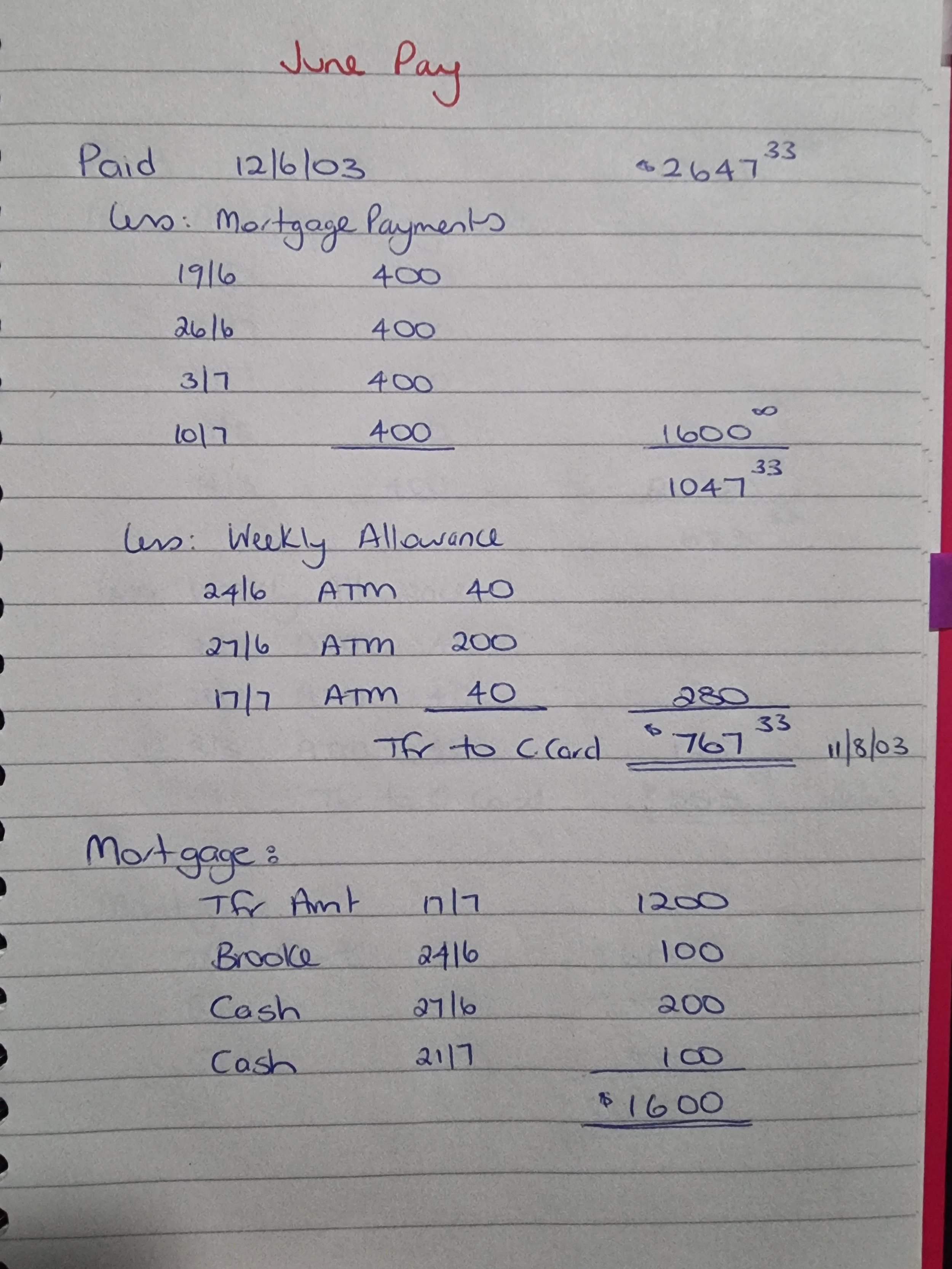
Just a pink lined notebook, a pen and my handwriting from June 2003.
At the top of the page I'd written June Pay.
Back then I was paid monthly (which, quite frankly, brings back some PTSD) and apparently this was how I made sure that one pay lasted until the next one.
My pay went in.
Mortgage payments came out.
I gave myself a weekly allowance.
There were cash withdrawals from the ATM, a transfer to the credit card and a running balance calculated by hand.
Nothing sophisticated about it.
But I knew where the money was going.
And looking at that page more than 23 years later reminded me that while the way we spend money has changed enormously, the basics of managing it really haven't.
Long before that notebook, I had already learned how important budgeting could be.
When I was at university, I lived on around $50 a week. Of that, $5 went back to Centrelink to repay a debt, leaving me about $45 to work with.
There wasn't much room for impulse purchasing in $45, especially when you needed to eat.
You learned where you could save a dollar because sometimes that dollar actually mattered.
I remember buying orange juice concentrate because it was cheaper. We'd pour it into a two-litre container, top it up with water and, as far as we were concerned, it tasted just like ordinary orange juice.
And then there was the Titanic poster.
Yes. Titanic.
I found a poster I wanted at a cheap shop near uni. I couldn't afford to simply buy it, so I put it on lay-by and paid it off at $2 a week.
Eventually, after handing over enough little $2 payments, I got to take my poster home.
That was completely normal.
When I started my first full-time job, my annual salary back in 1999 was only $23,000, but I thought I was rich after living off $50 per week. In my second year it increased to $25,000. Funny how those annual increases decrease over the years.
Suddenly there was rent to pay, bills to manage and, with no furniture or whitegoods, a monthly hire fee to pay as well.
I was earning more money than I'd ever had before, but I was also responsible for more things than I'd ever had before.
So budgeting wasn't really an optional extra.
It was just part of being an adult.
We used to wait
I don't tell these stories because I think everything was better back then.
It wasn't.
There are plenty of things about managing money today that are easier. We have online banking, automatic payments, apps, instant access to our account balances and countless tools that can help us understand where our money is going.
But we've also made it incredibly easy to spend.
When I put that Titanic poster on lay-by, the order of events was simple:
I wanted it.
I paid for it.
I waited.
Then I got it.
Today, we can often reverse that.
Want it.
Get it.
Work out how to pay for it afterwards.
Credit cards have been around for a long time, of course. Keeping up with the Joneses isn't a new invention either.
But now we've added Buy Now, Pay Later and Pay in 4 to the mix, along with online shopping that never closes.
Then add social media.
I didn't have influencers popping up on my phone while I was at university showing me what everyone was wearing, buying, driving, renovating or taking on holiday.
Comparison existed. Advertising existed.
But it wasn't sitting in my hand all day. It came weekly in your mailbox in the form of junk mail.
Perhaps the biggest change isn't that we suddenly want more things.
It's that we're now shown more things to want - and given incredibly easy ways to have them immediately.
Sometimes the first question should simply be “Why?”
One question we get reasonably often in the accounting world is some version of:
“Should I buy a new car?”
And sometimes my first thought is:
Why?
Is there something wrong with the car you've got?
Is it unreliable?
Are the repair costs getting ridiculous?
Do you need something different because your circumstances have changed?
Can you afford the new one?
Those questions matter.
Buying something simply because it might give you a tax deduction isn't necessarily a good reason to spend the money, particularly if you're going into debt to do it.
A new vehicle might initially mean fewer repair bills, but there are other costs to consider too. Insurance, finance and the actual purchase price don't disappear just because there may be a tax consequence.
Sometimes the decision needs more than a tax calculation.
It needs a bit of common sense.
And I can hardly pretend to be the poster girl for regularly upgrading cars.
In 2026, our household is still driving cars from 2002 and 2010.
Could we replace them?
Yes.
Do we need to replace them?
That's a different question.
You don't have to be good at numbers to be good with money
Perhaps that's the part we sometimes overcomplicate.
Budgeting doesn't have to mean an elaborate spreadsheet.
You don't necessarily need an app.
And you certainly don't need to be an accountant.
My June 2003 system was hardly revolutionary.
Money came in.
I wrote down what had to go out.
I allocated some money to myself.
I subtracted one from the other.
And I knew what was left.
That's really what a budget is.
It's not punishment. It's not about never buying anything fun. And it's not about having every dollar of your life perfectly controlled.
It's simply knowing enough about your own money to make an informed decision before you spend it.
Sometimes the answer will be:
Yes, I can afford that.
Sometimes it might be:
Yes, but something else will have to wait.
And occasionally the answer is:
Not yet.
I think not yet might be one of the most useful financial lessons I learned.
Because not yet doesn't mean you can never have the thing you want.
It means you wait.
You save.
You decide whether you still want it after you've had some time to think about it.
And perhaps, every now and then, you discover you didn't really need it after all.
More than 20 years after I wrote that June budget in an ordinary notebook, we have far more sophisticated ways to manage our money.
But I'm not convinced we need to make the basic principle any more complicated.
Know what you've got.
Know what you owe.
Know what you can afford.
And sometimes, be prepared to wait.
No fancy calculator required.
Although these days, I probably would use a spreadsheet.
Be real, not perfect. Be Kind. Be Brave. Be Yourself.