
Cash Is King - Especially When the Tax Bill Arrives
What the ATO's credit-card change should teach every small business about managing cash.
This week, the Australian Taxation Office (ATO) announced that after 30 November 2026 it will no longer accept credit-card payments.
And I raised an eyebrow.
Actually, I may have raised both.
The timing is particularly interesting because, from 1 October, Australian businesses can no longer add a separate surcharge to eftpos, Mastercard or Visa card payments. The Reserve Bank's reforms also reduce some of the fees within the payments system and are expected to lower merchant costs overall. But accepting card payments hasn't suddenly become free for every business. Reserve Bank of Australia
Some small businesses are already saying they'll have to absorb the remaining cost or build it into their prices. We've even seen reports of cafes increasing the price of a coffee rather than wearing the cost themselves. ABC News
And then, on 1 October, the ATO announced that it will stop accepting credit cards after 30 November. Accountants Daily
I can't help seeing some irony in that.
Businesses have just lost the ability to separately pass certain card-processing costs on to customers. We're told the wider reforms will reduce payment costs for businesses. And now the ATO - a government agency - will no longer accept credit cards.
As an accountant working with small businesses every day, I'm allowed to raise an eyebrow at that.
But this isn't really a blog about credit cards.
It's about cash.
Because cash - whether it's notes in the till or numbers on a screen - is still king in any business.
The trap nobody explains when you start a business
When someone starts a business, I will often recommend putting around 30% aside for tax purposes.
That isn't a magic tax rate and it won't suit every business. Your actual tax obligations depend on your structure, profit, other income and individual circumstances.
It's a cash-flow habit.
Because I've seen what can happen when nobody thinks about tax until the first tax return arrives.
Year One.
Perhaps you start your business part-way through the financial year. Things go well. You're making money. Fantastic.
Then we prepare the tax return.
There's a tax bill.
Except you haven't put anything aside for it, because every dollar coming into the business felt like your money.
Year Two.
Now you're trying to pay last year's tax bill while running this year's business.
Depending on your circumstances, you may also have entered the PAYG instalment system, meaning you're now prepaying amounts towards this year's expected income tax. Add GST and, if you employ staff, PAYG withholding into the mix.
Suddenly it can feel as though everything you make somehow ends up at the ATO.
Year Three.
Year Two may have been your first full financial year in business. Perhaps the business grew.
The PAYG instalments you've already paid are credited against your eventual tax liability, but they may not have been enough. There can be another tax bill to pay and your future instalments may increase as well.
PAYG instalments are designed to spread expected tax across the year rather than leaving one large bill at the end, but they don't guarantee there won't be a balance remaining when the return is prepared.
And this is where I've seen small businesses really struggle.
That's why I believe setting up the way you manage your money correctly from the beginning can be one of the smartest business decisions you'll ever make.
The system I encourage my clients to use
First, open a business bank account.
Business income goes in. Business expenses come out.
Then open a separate tax account.
When a customer pays you, put aside the GST component where applicable.
When wages are processed, put aside the PAYG withholding.
Make provision for your expected end-of-year income tax.
And if you're a sole trader in particular, think about putting money aside for your own superannuation too. Nobody else is automatically doing that for you.
The important part is psychological as much as financial:
The money in that tax account is not available spending money.
It already has a job.
Finally, if you're a sole trader or otherwise aren't receiving a conventional wage, establish a sensible regular amount that the business can afford to transfer to your personal account.
Then live your personal life from that account.
Which brings me to one of Accountant Brooke's favourite lectures.
Please stop using the business account as your personal wallet
Yes, sometimes something happens and you have to use it.
I'm talking about the habit.
I don't need your business records telling me how often you went to Macca's or KFC, what you bought at the footy canteen, how much you spent at the TAB or where you went on the weekend.
And yes, reviewing a long list of personal spending while simultaneously discussing why there isn't enough money available to pay the BAS can lead to some fairly frank conversations in my office.
There's another reason for keeping it separate too.
You're paying your accountant to look at all of this.
I know people don't particularly enjoy paying accounting fees.
If I see one transfer each week clearly identified as a personal drawing or regular payment to yourself, I know what it is. I can deal with it and move on.
But if I have to review 15 transactions from Saturday afternoon to determine whether they're business expenses or personal spending, that takes time.
And time in an accounting practice costs money.
You're effectively paying your accountant to discover that you bought a Quarter Pounder on Saturday.
I'd rather save you the money.
Keep it simple for yourself. Keep it simple for your bookkeeper or accountant. And keep personal spending in your personal account.
I've seen what happens when this works
I took over the affairs of a small-business client who, at the time, owed the ATO around $40,000.
Ultimately, he used his own money (personal savings) to clear that debt.
But from the time I became involved, we also changed the way the business handled its money.
Every time a customer paid, I transferred the GST component into the tax account.
Each week when I processed the wages, the PAYG withholding went across as well. Before the move to payday super, I used to transfer the superannuation provision too.
We treated that money as though it wasn't available to spend.
Did my client love watching money disappear into another bank account?
No. Not really.
Did it take time to build the system and recover from what had happened before?
Absolutely.
But slowly, he was able to repay himself the money he'd originally put into the business.
And the tax obligations?
The money is there when the deadline arrives.
Today, when he looks at the balance of his operating account, he has a much clearer idea of what the business actually has available.
That's the difference.
Cash flow doesn't mean paying everything in one enormous lump
Good cash management isn't just about tax.
Where it makes sense, I like using manageable instalments for other large business expenses too.
Council rates. Insurance. Workers compensation. Tax instalments.
Obviously you need to consider whether paying by instalments carries additional fees or costs. Sometimes paying annually is cheaper.
But there's a difference between something being cheaper on paper and a large lump-sum payment putting unnecessary pressure on the business's cash flow.
That's a conversation worth having.
What if you've been using a credit card to pay the ATO?
Would I ordinarily recommend funding tax obligations with a credit card?
No.
But I've also been an accountant long enough to know that real businesses don't operate inside textbooks.
Sometimes customers don't pay you when expected. Equipment breaks. Someone gets sick. Sales suddenly drop. Something completely outside your control happens.
And sometimes the BAS is due, the money isn't there and the credit card has been the only viable option available.
I'm not interested in judging a business owner for doing what they needed to do to get through that moment.
I'm interested in what happens next.
Why wasn't the cash available?
Is there something we can change?
Can we put a better system in place before the next obligation arrives?
That's why I think the ATO's decision to stop accepting credit cards matters. Businesses that have relied on that option as part of their cash-flow management now have a relatively short period to reconsider how they'll meet future obligations. Small-business groups have also raised concerns about the cash-flow impact of the change. Australian Financial Review
And if that's you, don't wait until the payment is due to have the conversation.
Your accountant should know your business
Your accountant shouldn't simply be someone you see once a year to lodge a tax return.
And your bank shouldn't only hear from you once you're already in trouble.
Those relationships matter.
If cash flow is becoming tight, talk about it early.
If something significant changes in your business, tell your accountant.
If you don't understand an obligation, ask.
If you're worried you won't be able to make a payment, don't hide from it and hope the problem disappears.
The best time to deal with a cash-flow problem is before the due date arrives.
Small business is hard enough without being blindsided by money you should have been putting aside all along.
I can't promise that separating your accounts will make paying tax enjoyable. I've been an accountant for 27 years and I'm yet to meet the client who gets excited about a BAS.
But I have seen the difference good systems make.
Know what belongs to the business.
Know what belongs to the ATO.
Know what you can afford to pay yourself.
And if the numbers aren't working, ask for help early.
Because cash - real or electronic - is still king in business.
And Future You really will thank you.
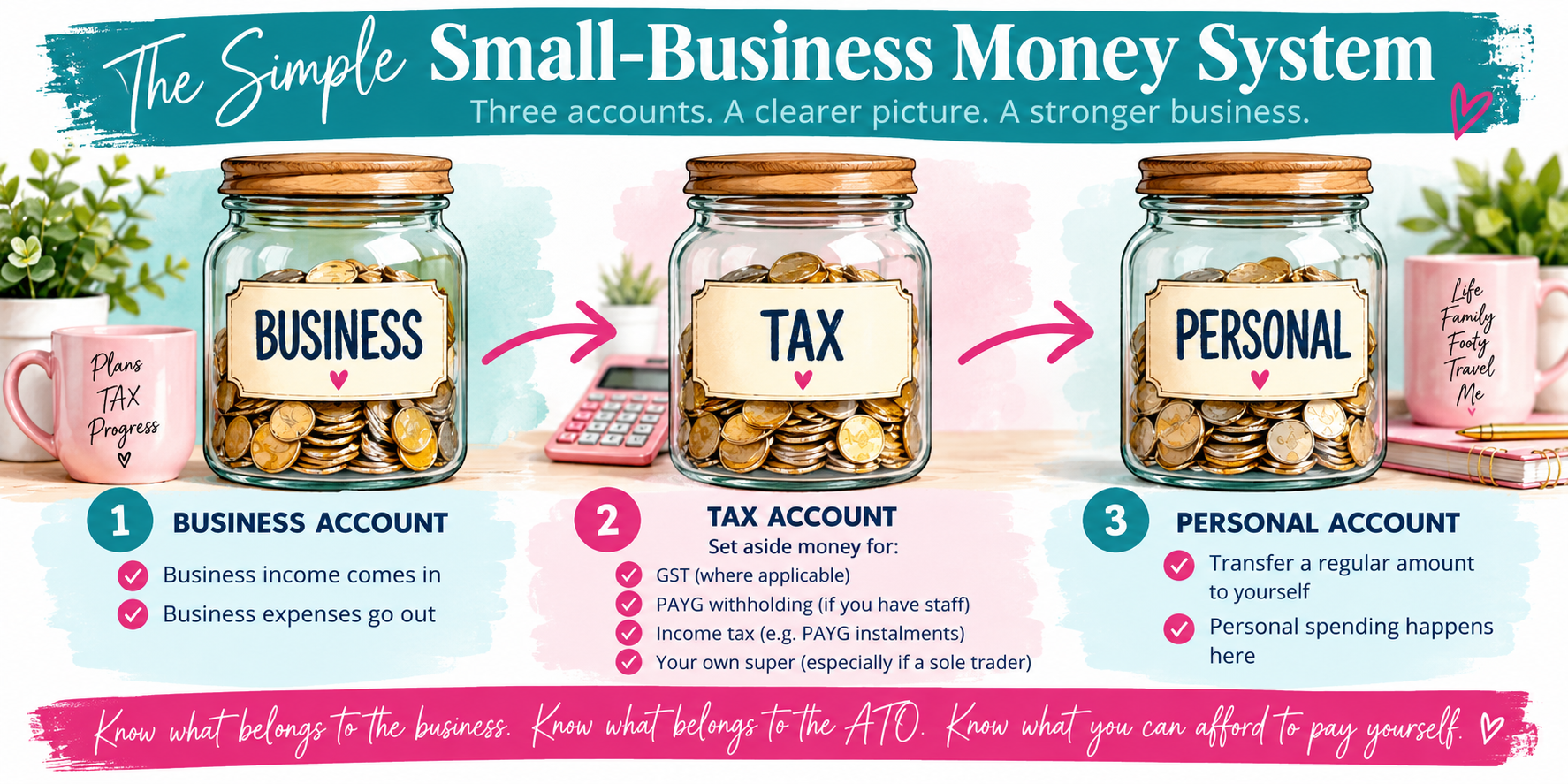
A simple three-account system for small business: use a business account for income and expenses, a separate tax account for GST, PAYG withholding, income tax and super where applicable, and a personal account for regular drawings and personal spending.