
What If You're Already in the Room?
There’s a phrase I hear quite a lot in business and personal development circles.
You need to get in the room.
Get in the room with people who are doing what you want to do. Get in the room with people who know more than you. Get in the room if you want to be seen, heard, challenged or given opportunities.
And I understand the theory.
We even use another version of it in everyday life. When something interesting is happening, we say we’d love to be a fly on the wall. We want to know what was said. Who said what. What really happened.
We want to be in the room.
But I had a thought in the shower this week.
What happens when you get in the room... and still don’t feel like you belong there?
Because I think I’ve spent quite a lot of my life in the room.
And quite a lot of my life wondering whether I should be there.
Maybe that goes back further than I realise.
I grew up out of town and caught the bus to and from school every day. When the school day finished, I went home. There wasn’t the same opportunity to hang around afterwards, walk home with friends or casually be part of whatever happened next.
Maybe somewhere along the way I became accustomed to feeling just a little bit outside the circle.
Maybe I carried some of that with me.
I’d like to say you grow out of those things.
I’m 49.
Apparently not.
I’ve been an accountant for 27 years. I’m qualified. I have decades of experience. I have clients who trust my advice.
But I’m not the owner of the practice. I don’t have the most qualifications. I don’t have the most experience.
There is always another level.
I could study more. Gain another qualification. Give more time. Spend more money. Chase the next thing.
But I don’t want to.
And that’s an interesting thing to admit.
Because if I don’t want what is required to get to the next room, why does part of me sometimes question whether I deserve my place in the room I’m already in?
I’ve felt it in other parts of my life too.
I’ve served on committees and still wondered whether I really belonged there.
I’ve stood behind my market stall surrounded by things I’ve made with my own hands and wondered whether they pass the test.
People stop. They look.
“That’s nice.”
“Wow, you made all this?”
Sometimes they buy.
Sometimes they tell me they could get something cheaper somewhere else.
Sometimes they ask whether people still wear things like that.
Sometimes they simply walk away.
And although that’s just part of selling handmade products at a market, when you made the thing sitting on the table, it can be surprisingly difficult not to hear a judgement of the product as a judgement of you.
I’ve been to business conferences where there are hundreds of people in the same room, yet there are other rooms within the room.
The people who have achieved certain ranks or results get invited into those spaces. They’re asked to train. They’re asked for their opinions. They’re recognised.
If you’re not at that level, you can be physically standing in the room and still feel a long way from the conversation.
And perhaps nobody has actually done anything wrong.
Sometimes rooms genuinely have hierarchies. Sometimes there are cliques. Sometimes access depends on qualifications, money, results, popularity, rank or simply knowing the right people.
But sometimes the room may be perfectly welcoming and we bring an old story through the door with us.
They probably know more than I do.
I’m not really one of them.
I haven’t done enough yet.
Maybe I shouldn’t be here.
Maybe that’s imposter syndrome.
Maybe it’s the little girl who got on the bus while everyone else seemed to stay behind.
Maybe it’s simply human.
I don’t know.
And this isn’t only about professional rooms.
Sometimes you can feel on the outside in your social life. If you don’t drink - alcohol or caffeine, don’t go out much or aren’t part of the places where people regularly gather, you can miss conversations and connections.
People stop checking in. Life moves on.
Nobody deliberately excluded you.
But somehow you ended up outside the room anyway.
You can even experience it within your own family as everyone develops their own schools, workplaces, friendships and lives.
Perhaps the strangest part is that you can be surrounded by people and still feel forgotten.
And then there are the times when we do exactly what we’re told to do.
We ask.
We make the appointment.
We explain that something doesn’t feel quite right.
We try to advocate for ourselves.
But if there isn’t anything obvious to see, there isn’t necessarily an obvious next step.
And that can leave you wondering what you’re supposed to do next.
You got in the room.
You spoke.
You asked.
But did you feel heard?
I don’t think that’s limited to a doctor’s room.
It happens at work. At home. In friendships. In relationships. In business.
Sometimes women are doing everything we’re encouraged to do - showing up, speaking up, asking questions, asking for help - and still wondering whether anybody really sees them.
Which brings me back to the reason I’ve spent September putting 30 different colours on my lips.
The lipstick is visible. The struggle isn’t.
For seven years, I’ve participated in Liptember.
There is plenty of fun involved.
The voting. The colours. The occasional lipstick that makes me question why I ever agreed to let Facebook choose what goes on my lips.
But underneath all that colour is something much more important.
Women’s mental health doesn’t necessarily have a face.
Someone can go to work. Make dinner. Answer emails. Drive the kids around. Turn up to appointments. Volunteer. Run a business. Sit on a committee. Post a smiling photograph.
Put on bright lipstick.
And still be struggling.
For 27 days, I’ve deliberately put something visible on my face to help start conversations about things that so often aren’t visible at all.
And maybe that’s why this year’s Liptember has made me think so much about belonging.
Because perhaps we spend too much time telling people how to get into the room and not enough time thinking about what happens once they’re there.
Who hasn’t spoken for a while?
Who stopped coming?
Who used to message but doesn’t anymore?
Who asked for help once and never asked again?
Who is sitting at the table but still seems slightly outside the conversation?
Who looks completely fine because they’ve become very good at looking completely fine?
And perhaps we need to turn some of those questions back towards ourselves too.
Am I actually being excluded?
Or am I still waiting for someone else to tell me I’ve earned my place?
Do I really want to get into the next room?
Or have I simply been told that ambition means I should?
What if I don’t need another qualification, another rank, another invitation or another achievement before I’m allowed to feel comfortable with where I already am?
Maybe at 49 I don’t need to grow out of the little girl who sometimes felt like she was on the outside.
Maybe I just need to stop letting her decide whether the woman I’ve become has earned her seat.
As my seventh Liptember comes to an end, perhaps that’s the thought I want to leave behind.
Yes, invite people into the room.
Make space at the table.
Listen when someone asks for help.
Notice the person who has gone quiet.
Check on the person you haven’t heard from in a while.
But also look at your own chair.
You might already be in the room.
You might already have earned your place.
You might already know enough to contribute.
You might already be enough for the conversation.
Maybe you’ve just been waiting for somebody else to tell you.
And while the lipstick might be visible, the things each of us carries rarely are.
So perhaps we could all spend a little less time deciding who belongs in the room...
...and a little more time making sure the people already there know that they do.
Be real, not perfect. Be Kind. Be Brave. Be Yourself.
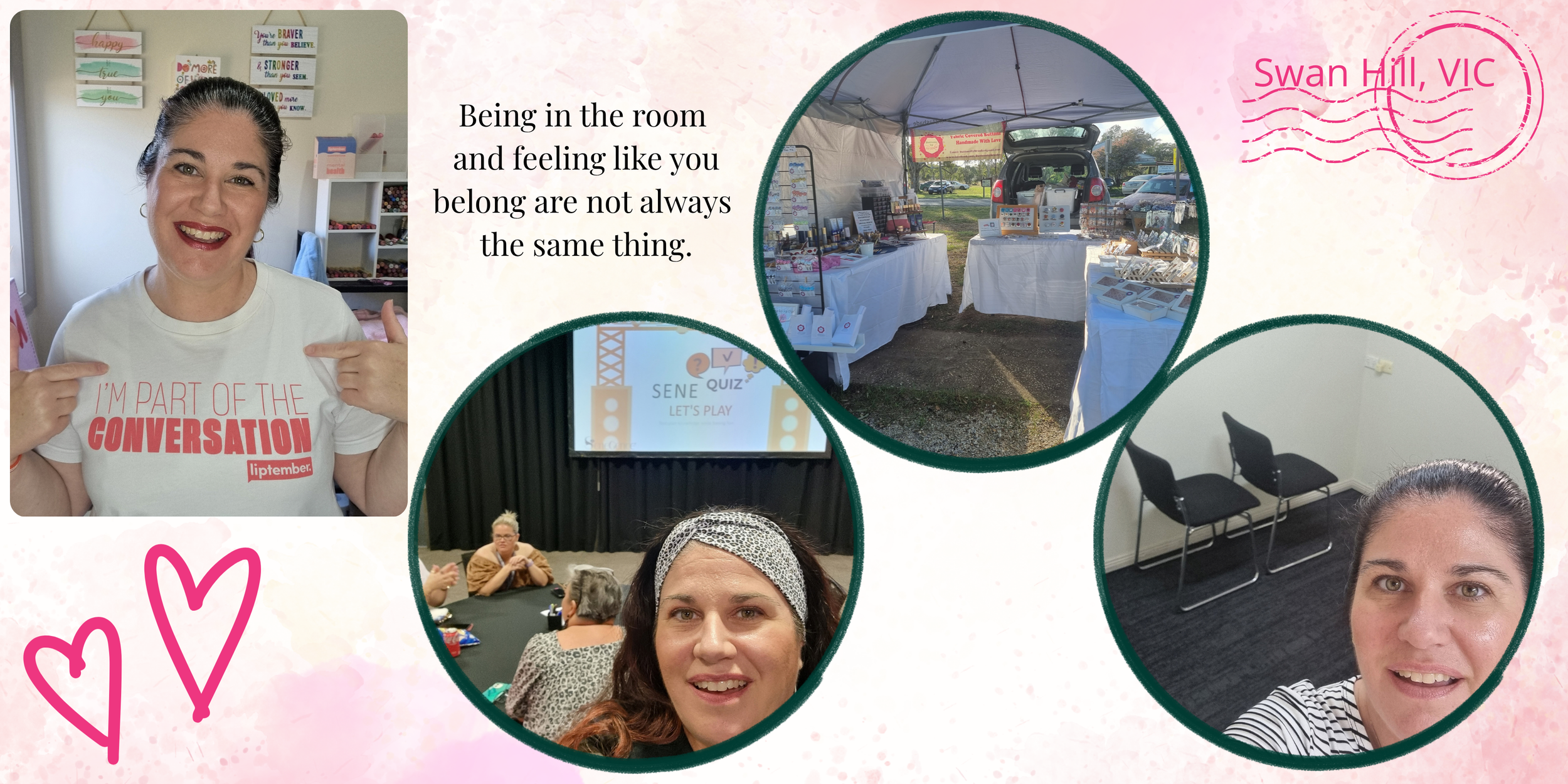
What If You’re Already in the Room?
A Beaute Circle Blog reflection on belonging, self-doubt and women’s mental health during Liptember 2026.